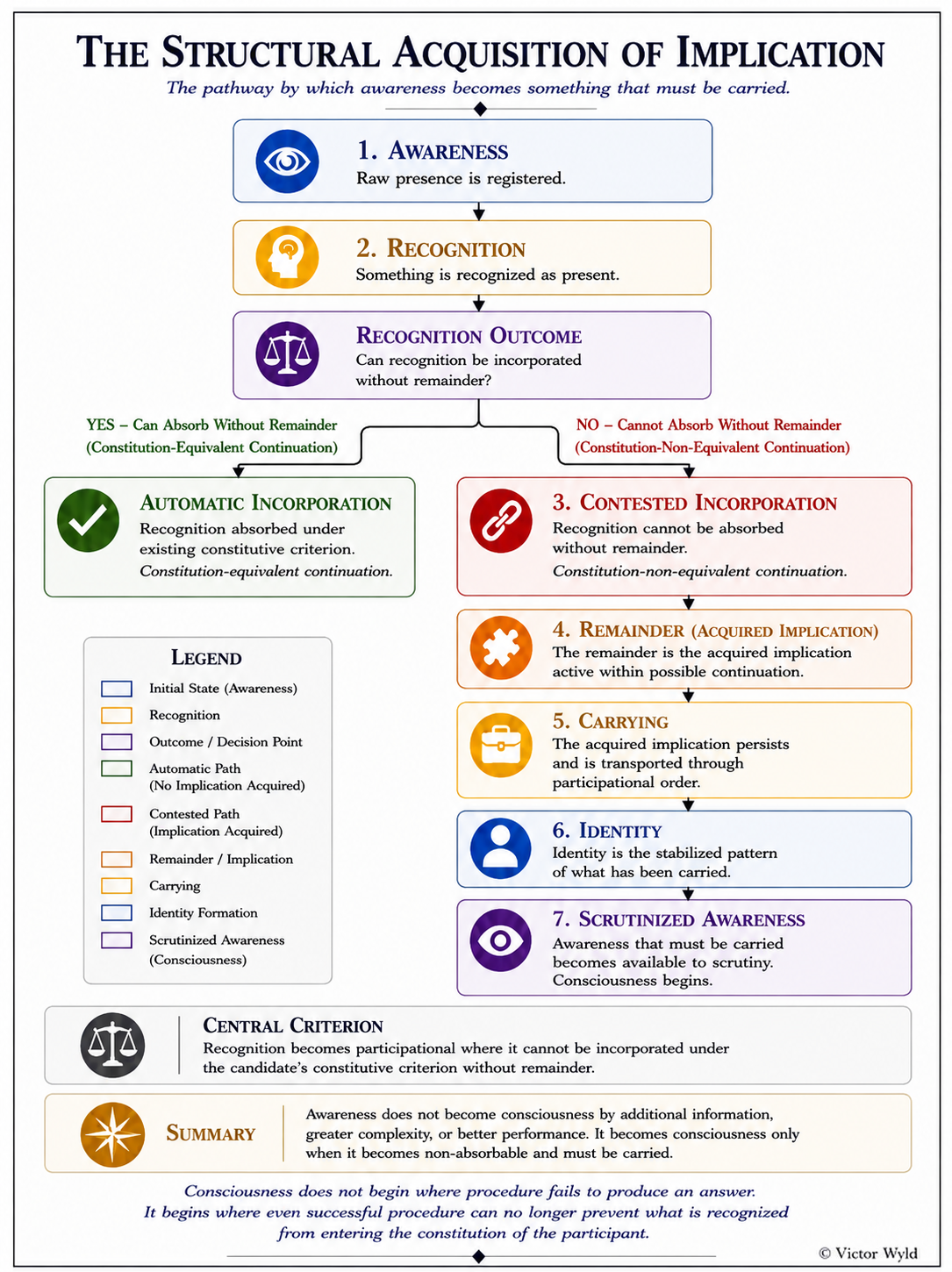
The Structural Acquisition of Implication presents the central architecture developed in Victor Wyld’s The Acquisition Problem.
The figure maps the pathway by which awareness can become something a participant must carry. Recognition reaches a structural decision point: can what has been recognized be incorporated without remainder?
If it can, continuation remains constitution-equivalent. If it cannot, recognition enters contested incorporation and may leave a remainder that persists across continuation.
What the figure represents
The decisive transition is not simply from ignorance to knowledge. A system may recognize, represent, store, and act upon information without acquiring that information as implication.
Participational recognition occurs when what is recognized implicates the participant and cannot be absorbed under the existing constitutive criterion without remainder.
That remainder makes carrying possible. Carrying, in turn, allows the acquired implication to participate in subsequent continuation and contribute to identity.
The figure therefore locates acquisition at a structural threshold: recognition becomes participational when continuation can no longer remain constitution-equivalent to what it was before the recognition occurred.
From: The Acquisition Problem: Participational Recognition and the Structural Acquisition of Implication by Victor Wyld.