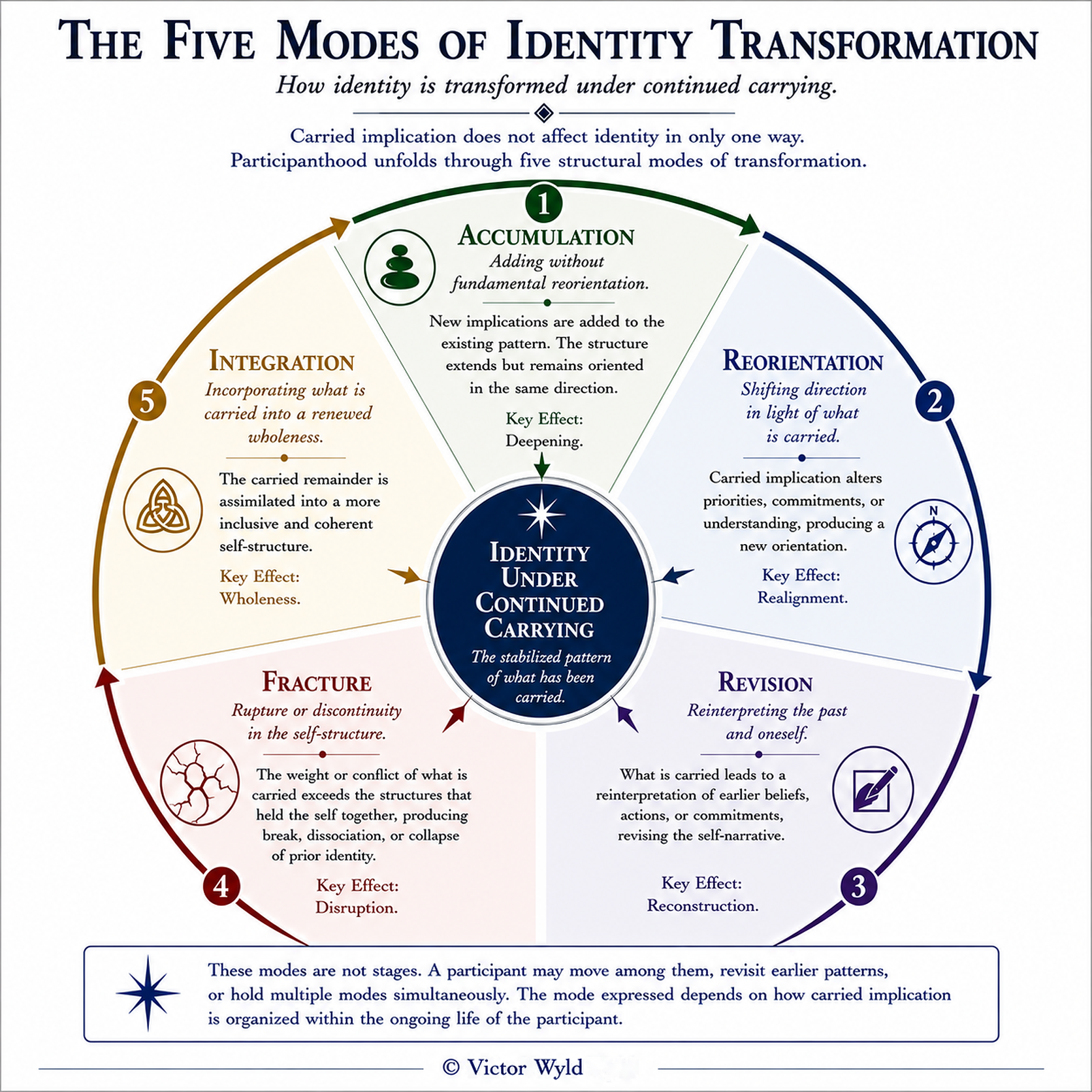
The Five Modes of Identity Transformation identifies five ways in which continued carrying can alter identity within Victor Wyld’s account of participanthood.
The five modes are accumulation, reorientation, revision, fracture, and integration.
They are not presented as chronological stages. More than one mode may be active within the continuing life of a participant, and the same carried implication may contribute to different modes over time.
What the figure represents
Accumulation occurs when carried implications become part of identity without requiring major reorganization. Reorientation alters the direction or priorities under which the participant continues.
Revision involves a restructuring of an existing self-understanding. Fracture marks a more substantial disruption in the continuity or organization of identity. Integration occurs when previously destabilizing or unresolved implication becomes incorporated into a reorganized continuity.
These modes describe changes in the participant rather than merely changes in information available to the participant. Their significance depends upon implication being carried across continuation.
Identity, on this account, is therefore not a static description or stored self-model. It is the stabilized pattern of what has been carried and how that carrying has altered continuation.
From: The Participanthood Problem: Identity Under Continued Carrying by Victor Wyld.