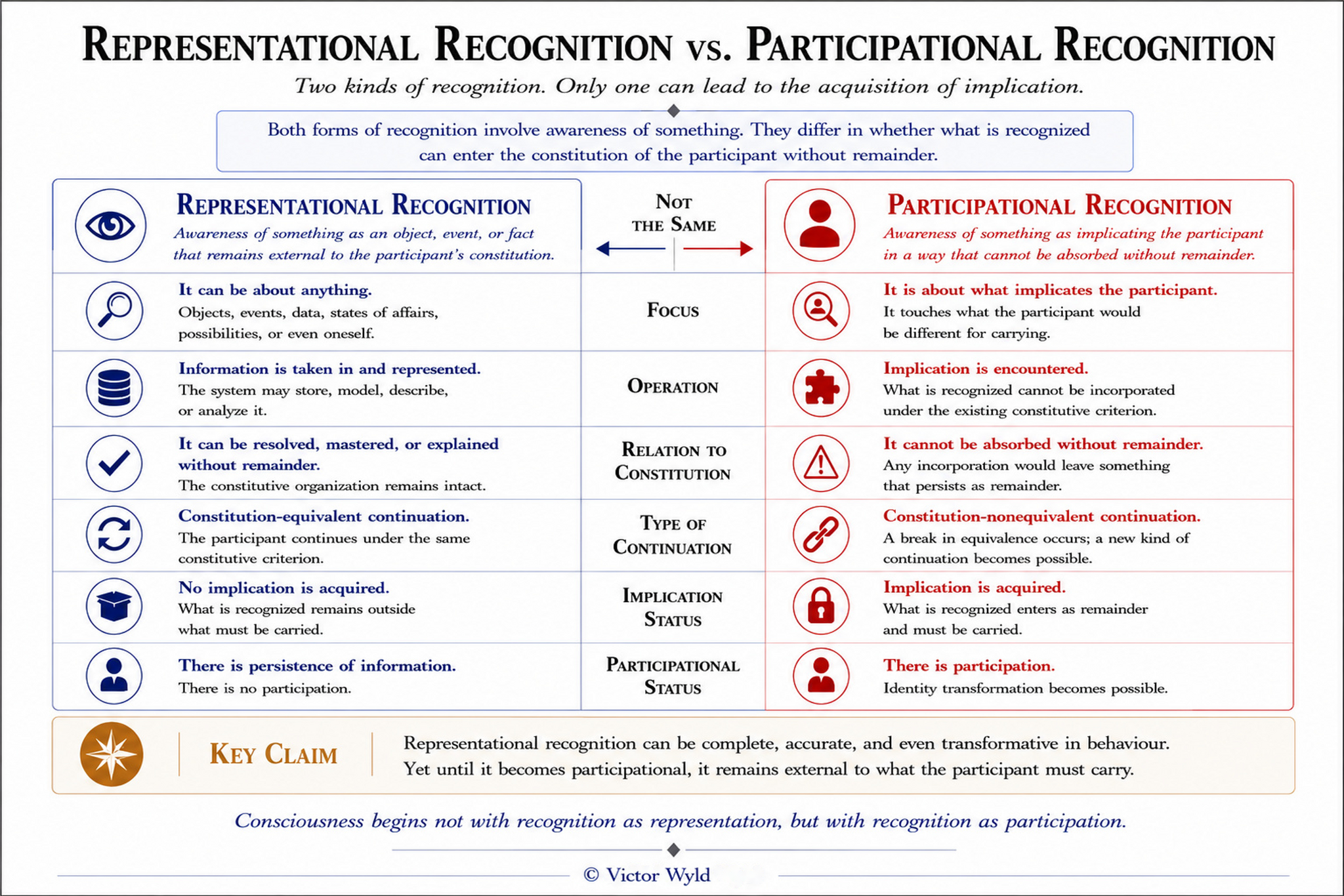
Representational Recognition vs. Participational Recognition illustrates a central distinction in Victor Wyld’s The Acquisition Problem.
Representational recognition occurs when a system recognizes, represents, classifies, or responds to something without that recognition becoming constitutively significant to the system’s own continuation.
Participational recognition occurs when what is recognized implicates the participant and cannot simply be absorbed without remainder.
What the figure represents
Recognition alone does not establish acquisition. Information may be identified accurately, stored indefinitely, incorporated into a model, or used to alter behaviour while remaining external to the participant’s constitution.
The participational case begins when recognition changes the structural relation between what has been recognized and the entity that must continue after recognizing it.
If recognition cannot be incorporated under the existing constitutive criterion without remainder, the recognition becomes implicated in continuation. That remainder makes carrying possible and creates the conditions under which identity may be altered.
The distinction therefore separates knowing or representing something from acquiring it as implication. The former can remain detachable from the participant; the latter becomes part of what continuation must carry.
From: The Acquisition Problem: Participational Recognition and the Structural Acquisition of Implication by Victor Wyld.