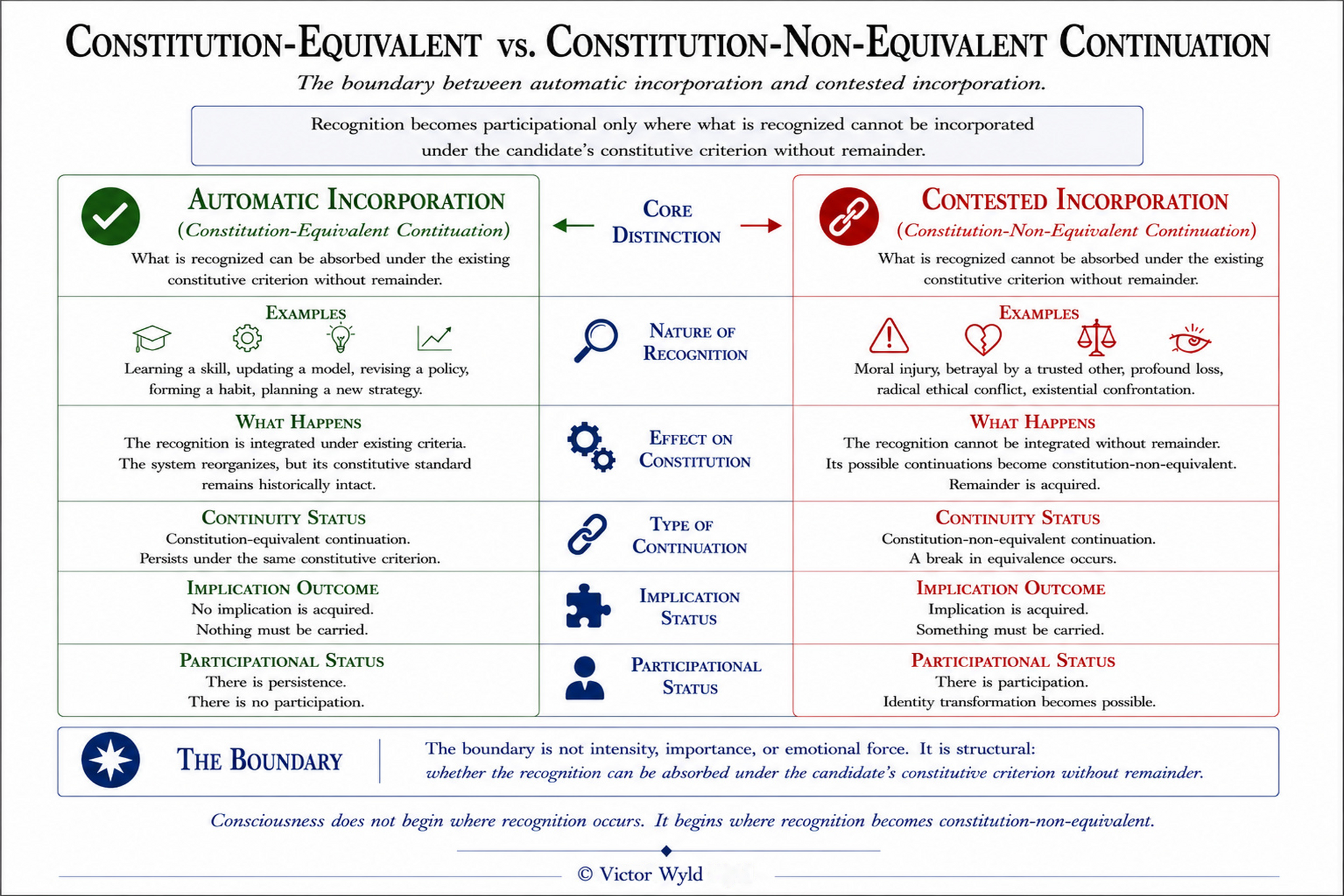
Constitution-Equivalent vs. Constitution-Non-Equivalent Continuation identifies a central structural boundary in Victor Wyld’s The Acquisition Problem.
The decisive question is whether what has been recognized can be incorporated under the participant’s existing constitutive criterion without remainder.
If it can, continuation remains constitution-equivalent. If it cannot, the recognition enters contested incorporation and continuation becomes constitution-non-equivalent.
What the figure represents
Constitution-equivalent continuation does not mean that nothing has changed. A system may acquire information, update beliefs, revise a model, alter behaviour, or modify a policy while remaining structurally equivalent in the relevant sense.
The distinction turns on whether the recognition can be absorbed without leaving an unresolved implication that must persist across continuation.
Constitution-non-equivalent continuation begins when what has been recognized cannot be incorporated without remainder. The participant must thereafter continue in relation to something that its prior constitution could not simply absorb.
The figure therefore locates the boundary between automatic incorporation and contested incorporation not in intensity, importance, or emotional force, but in whether recognition changes the constitutive terms under which continuation remains possible.
From: The Acquisition Problem: Participational Recognition and the Structural Acquisition of Implication by Victor Wyld.