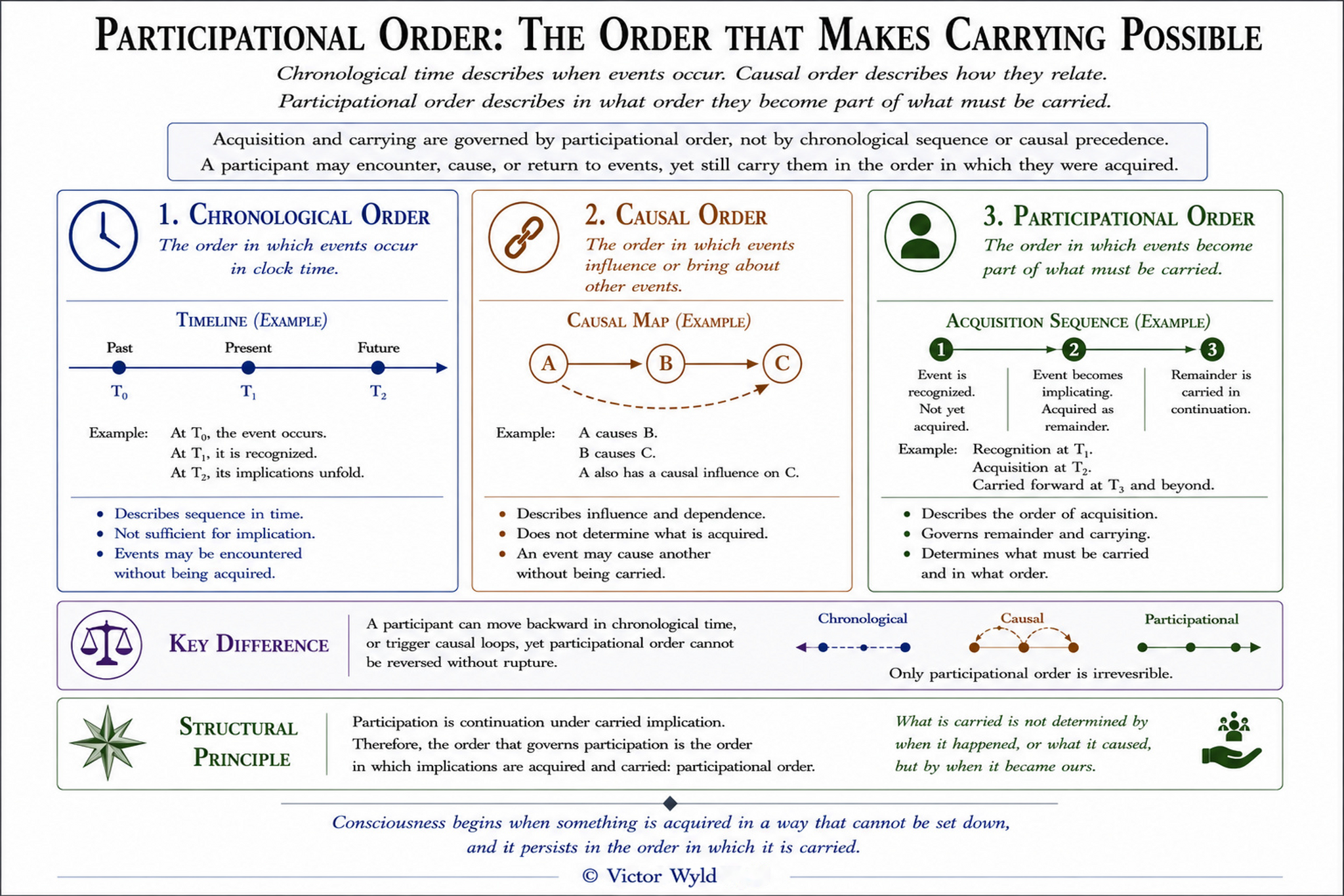
Participational Order: The Order That Makes Carrying Possible distinguishes three different ways in which events and implications can be ordered within Victor Wyld’s The Acquisition Problem.
Chronological order concerns when events occur. Causal order concerns how events produce or influence one another. Participational order concerns the sequence in which implications are acquired and become part of what a participant must carry.
These orders can overlap, but they are not equivalent.
What the figure represents
An event may occur earlier without becoming participationally prior. Likewise, one event may causally produce another without determining the order in which their implications become constitutively significant to the participant.
Participational order begins with acquisition. What matters is when a recognition becomes implication, enters carrying, and thereby alters the conditions under which subsequent continuation occurs.
This matters because later implications are not encountered by an unchanged participant. They are encountered by a participant already structured by what has previously been carried.
Participational order therefore identifies the order that makes carrying historically consequential: each acquired implication can alter the constitutive context in which later implications are received.
From: The Acquisition Problem: Participational Recognition and the Structural Acquisition of Implication by Victor Wyld.