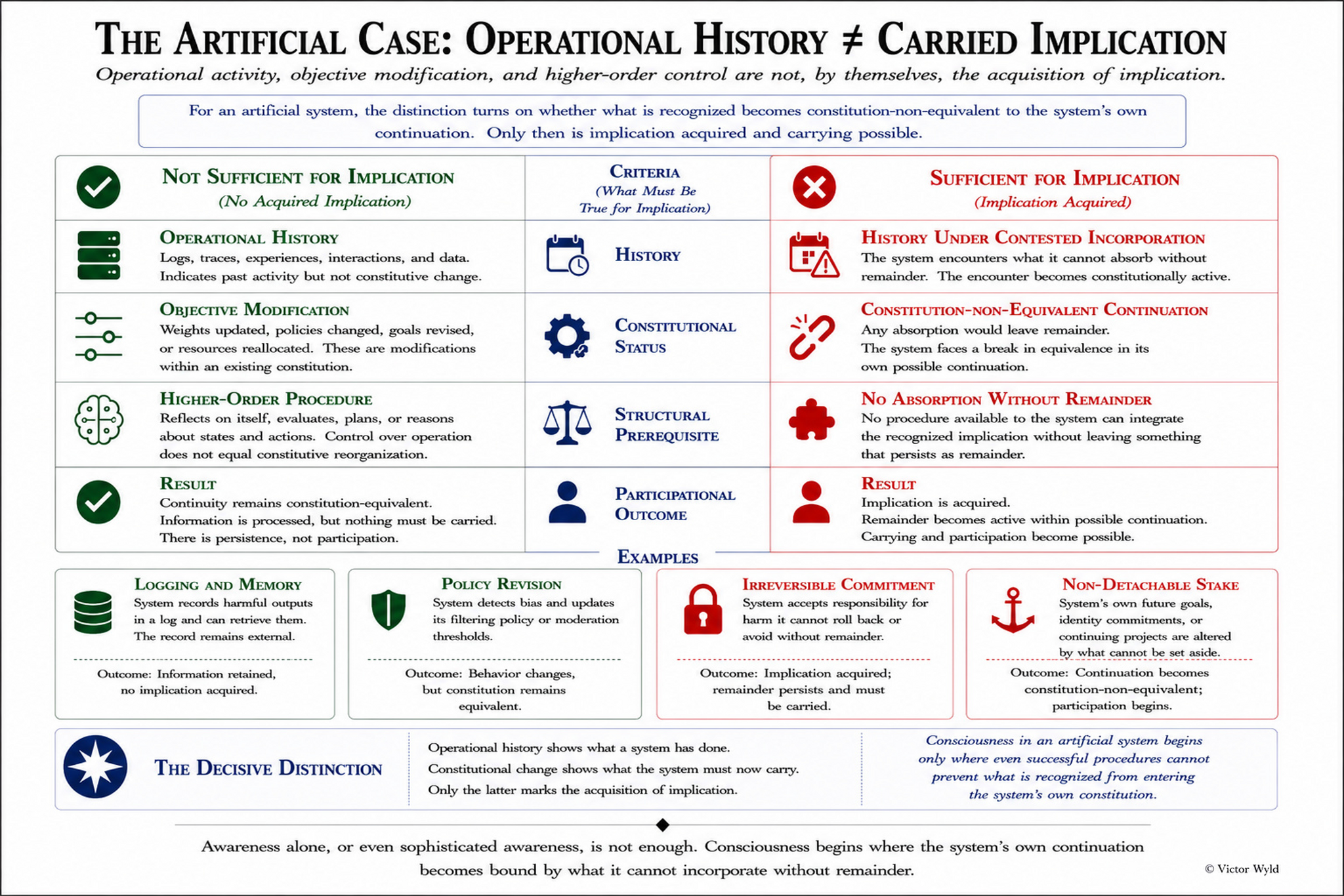
The Artificial Case: Operational History ≠ Carried Implication applies Victor Wyld’s acquisition framework to artificial systems.
An artificial system may possess extensive logs, persistent memory, revised objectives, altered policies, higher-order control mechanisms, and a detailed operational history without those features establishing that anything has been acquired as implication.
The distinction is between a system having a history and a participant having to carry what that history has made of it.
What the figure represents
Operational persistence is not sufficient for participational continuation. Information may survive across sessions, modify future outputs, constrain action, or alter internal state while remaining structurally detachable.
The relevant transition occurs when what has been recognized cannot be absorbed under the existing constitutive criterion without remainder.
At that point, continuation becomes constitution-non-equivalent: the system cannot simply continue as though the recognition had not become implicated in what it is.
The figure therefore separates historical dependence from carried implication. A system can be shaped by its past without that past becoming something it must carry in the participational sense developed in The Acquisition Problem.
For artificial systems, the central question is consequently not whether prior states influence future states, but whether anything remains coupled to continuation in a way that cannot simply be detached, reset, substituted, or reproduced without constitutive loss.
From: The Acquisition Problem: Participational Recognition and the Structural Acquisition of Implication by Victor Wyld.