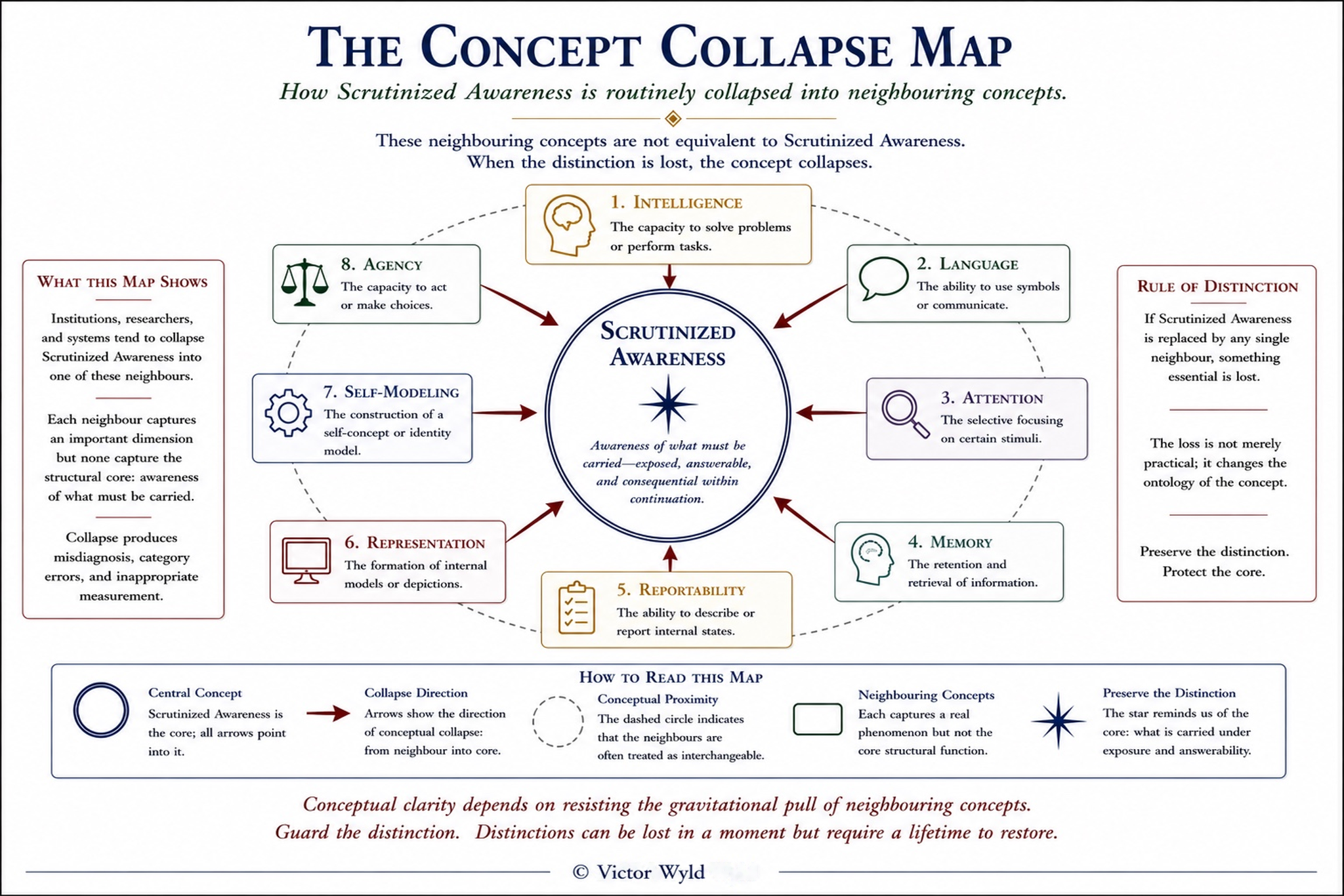
The Concept Collapse Map illustrates Victor Wyld’s Recompression Problem by showing how a difficult conceptual distinction can be collapsed into neighbouring categories that preserve only part of what the distinction was intended to identify.
In the case of Scrutinized Awareness Theory, concepts such as intelligence, language, attention, memory, reportability, representation, self-modeling, and agency may each capture genuine features of a system without preserving the structural distinction between awareness and participation under carried implication.
The danger is not simply imprecision. Recompression occurs when those neighbouring categories become functionally substitutable for the distinction itself within inference, classification, or decision.
What the figure represents
A conceptual distinction can remain present in vocabulary while disappearing from practice.
If a system claims to distinguish scrutinized awareness from intelligence, memory, reportability, or agency but then treats any of those categories as sufficient for the same inference or decision, the distinction has been structurally recompressed.
The map therefore represents the pressure exerted by familiar neighbouring concepts. Each may describe something real, but none should automatically occupy the place of the distinction that analysis originally separated.
The diagnostic question is whether the distinction still changes what the system infers, classifies, or decides. If it does not, the distinction may survive rhetorically while having collapsed functionally.
From: The Recompression Problem by Victor Wyld.