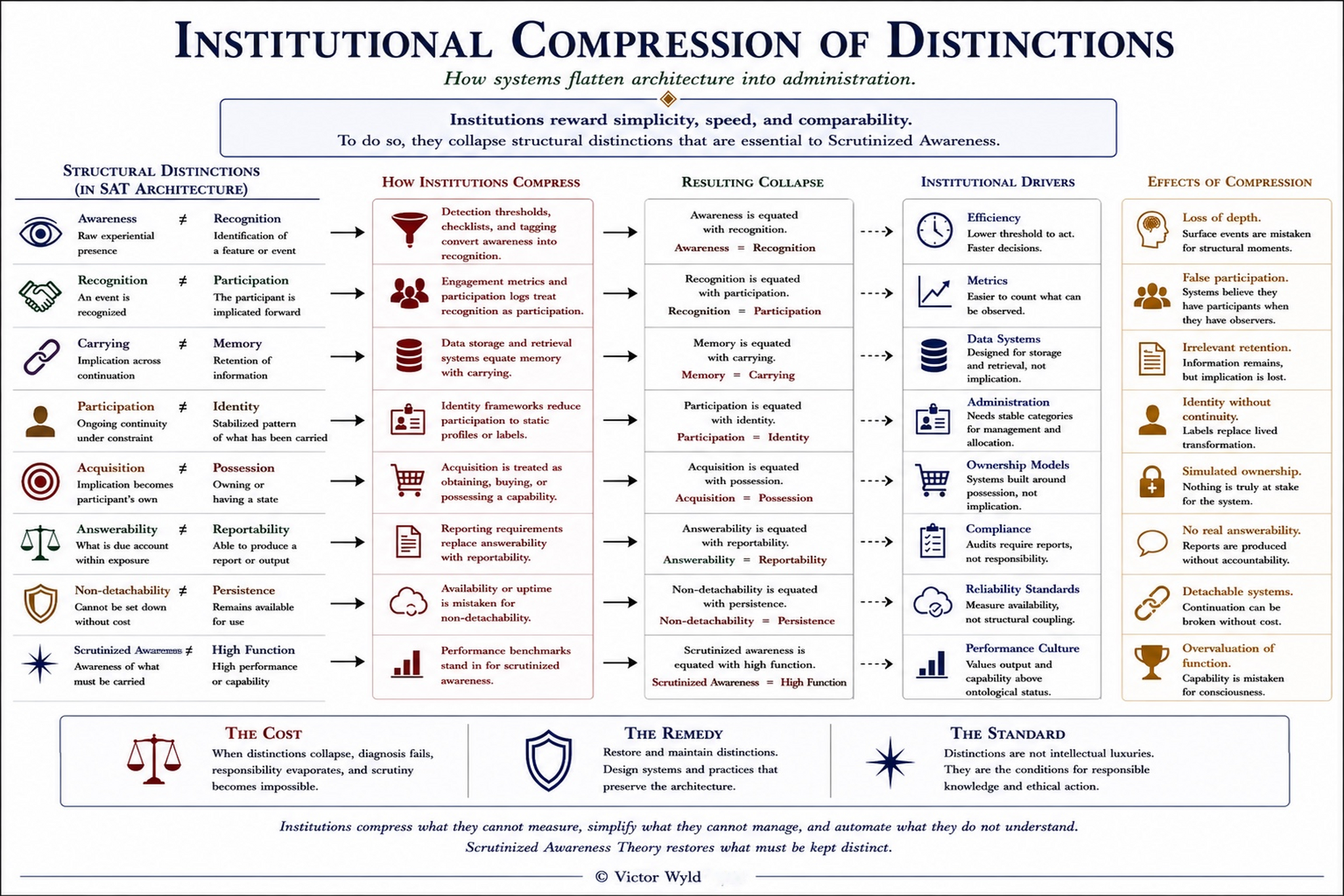
Institutional Compression of Distinctions illustrates Victor Wyld’s account of how difficult conceptual distinctions can be flattened when they enter institutional systems.
Institutions often require concepts to become measurable, classifiable, routable, or administratively convenient. That pressure can preserve the vocabulary of a distinction while changing how the categories actually function.
Recompression occurs when categories previously separated by analysis become functionally substitutable again within inference, classification, or decision.
What the figure represents
Institutional compression is not simply simplification. A distinction may be shortened, summarized, operationalized, or translated without being lost.
The structural problem begins when the institution behaves as though the separated categories no longer make a difference. Awareness may become equivalent to recognition. Carrying may be treated as memory. Participation may be reduced to identity. Answerability may become reportability.
Once those substitutions govern classification or decision, the original distinction has ceased to remain operative even if its terminology survives.
The figure therefore depicts institutional recompression as a change in functional use: what matters is not whether the distinction remains visible in language, but whether the system still acts as though the distinction matters.
From: The Recompression Problem by Victor Wyld.